It is 2026 and I think that if you have not been in some sort of therapy (psychologists, psychiatrists, clinical social workers, licensed professional counselors, or marriage and family therapists, pastor, priest, tarot, or even freaking astronomy) by now I may be looking at you like this:

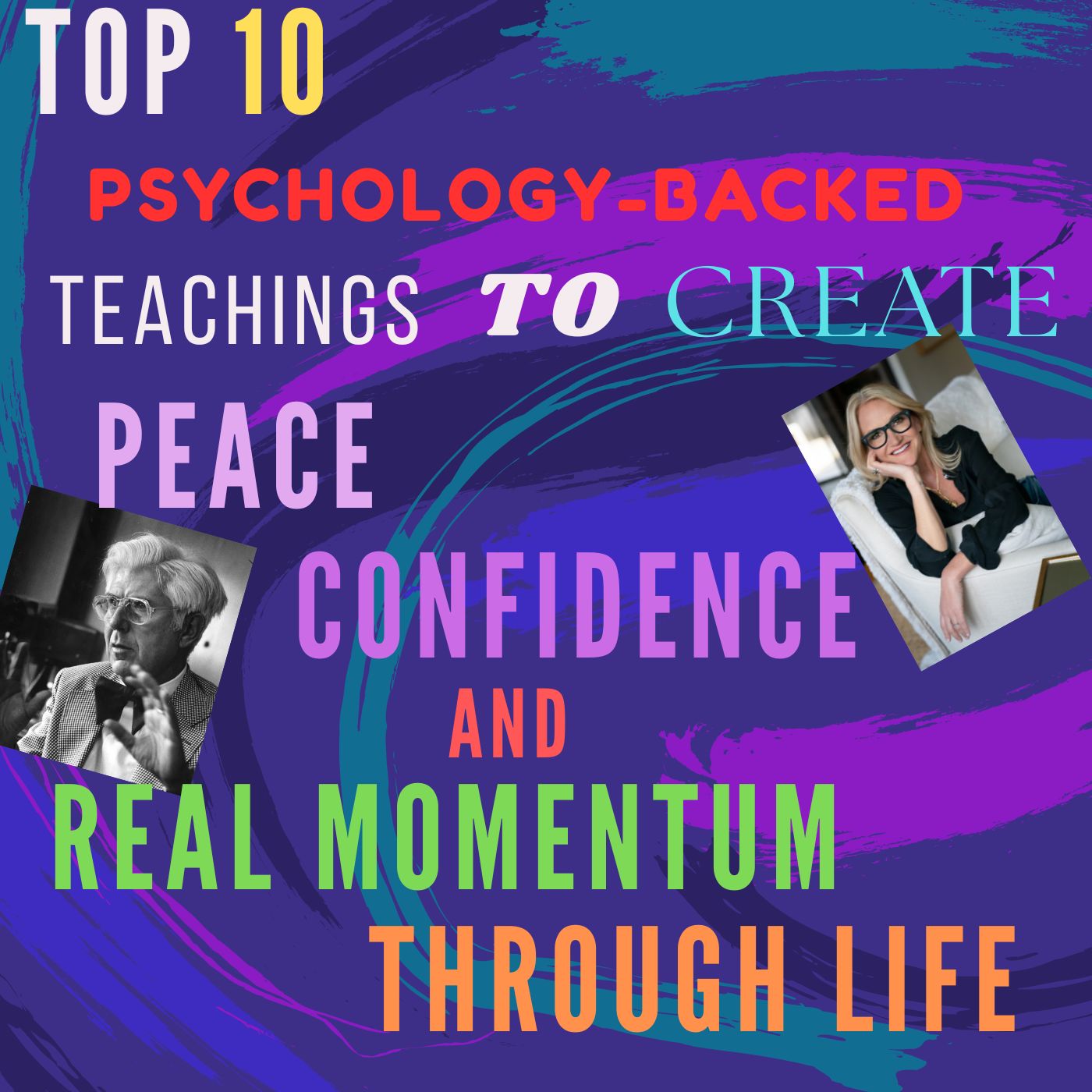
I am going to be super personal in this post and put modern teachings, personal advice, and how it may help you (I am obviously not a doctor-I just know the world is fucked right now). If you have spent any time in the personal development world, you’ve likely encountered very similar theories from Mel Robbins to Aaron T. Beck. While you are learning about becoming a happier, more confident, and just a better person-you can not help but feel like the behavioral suggestions are modern and punchy, but they are deeply rooted in established psychological research. So I am going to break down Mel Robbin’s suggestions and how they are backed by theories in behavioral psychology, neuroscience, and cognitive sciences but also how to implement them to build peach and get ahead in life.

1. The 5 Second Rule & Behavioral Activation
Mel Teaches: Count 5-4-3-2-1 and move before fear stops you
Psychology Behind It: This aligns with behavioral activation, a treatment method developed within Cognitive Behavioral Therapy (CBT), pioneered by psychologist like Aaron T. Beck. Depression and anxiety thrive in avoidance. Action interrupts avoidance loops.
Action precedes motivation
How to Implement It:
- Use 5-4-3-2-1 when procrastinating.
- Interrupt anxious rumination with physical movement.
- Start tasks before your brain understands that you are ready.
You’re re-training your brain through behavior and creating a habit of not being anxious or scared. But do not be confused. You do not have to be scared to use this technique. You do not have to be anxious. This technique also helps procrastination. Are you in a loop of watching TikTok’s because you are avoiding tomorrow? Close your eyes, count down from five-but the phone away. You turn off your alarm in the morning and do not want to get out of bed. Count back from five then get out of bed until it just becomes habit for you to do what you are avoiding doing.
How I used It:
I was talking to my therapist about feeling like I always had to do everything. I had so much on my plate that I didn’t know what to do next. And I have ADD so my brain jumps around a lot. Example:
If I know I have to do the dishes, I know I have to put them away first most likely-but then I also know that I need to sanitize the dishwasher, so I need to do that before I do the dishes…but before I sanitize the dishwasher I should probability start the laundry because I can be doing both things at once…but if I start the laundry I need to separate the colors-but I do not have enough whites so I need to strip the bedding...
and so on. Literally causing me to be in a paralysis state. So I she told me to count down. If I felt the urge to start at 3 then start at 3 (5-4-3…) but by the time I got to one-just start on what the first thought was. Just the dishes. All the other tasks that caused by brain to become overwhelmed can be done later rather not at all because of the paralysis, but not before the first tasks that comes to mind.
I even do this while playing video games. Start the laundry while it is the Sims are sleeping (gives me a specific time to justify I did something productive but also get to go back relaxing). Then come back and play the game. Set a timer on how long to read a book and then go to bed. Setting a timer helped my brain count down to a specific task and counting down helped me start a task.

2. The Let Them Theory & Locus of Control
Mel’s Teaching: Let people judge, misunderstand, not include you, or doubt you. You control your response.
Psychology Behind It: This aligns with the concept of locus of control, introduced by psychologist Julian Rotter. Peace increases when you shift your internal control.
External Locus: Life happens to me.
Internal Locus: I control my responses.
How to Implement It:
- When someone criticizes you -> ask, “Is this within my control?”
- Stop trying to manage other’s perceptions or actions.
- Redirect focus to your behavior.
Stress decreases when you stop fighting uncontrollable variables. And this teaching is not groundbreaking. It is not a new thought. I feel like people with high self-confidence already have this technique hard-wired into their brains somehow, but I feel like I had to really look inwards and take responsibility on learning how to let other’s make their own decisions. This does not mean that you let people walk over you, disrespect you, or have any sort of power over you. It is about your reactions to being left out, criticized, or even disrespected. It is about finding your peace. Your power. So if you let someone be who they are-make decisions the way they want too, it is up to you to decide if you still want that person in your life.
How I used It:
I have always felt like a weirdo. I tried so fucking hard in middle school to be accepted. I joined cheerleading. I did all the social events my friends were interested in. I went above and beyond to like what everyone else liked because I was trying so hard to not show how difficult my home life was. I just wanted to be happy. Accepted. Like everyone else. But when I would find that friend-that person that seemed to like me for me, I was never really able to keep them around. And then I moved a lot. Never really fit in attending high-school. I was working a job before school and a job after school because I had bills to pay. My life was different. I was different.
Never made life-long friends in college (always had my family and I met my husband in high-school so that’s not what I am talking about). Just that “adult” friendship. When I was a little bit older I finally found that girl that just fucking got me and we had so much fun doing shenanigans and shit. That person where you can be around each other and not say a word and both bust out laughing for no reason. So when I thought I found my person but realized that I really didn’t… but she met someone else who was her person-it broke me.
So back to therapy. She knew that I am hella good at detachment she taught me this: Locus of control, which is Mel Robbin’s Let Them Theory. Essentially-I can not make anyone do anything they do not want to do. Everyone has their own lives. Their own wants. Their own needs. Everyone has behaviors that they have already hard-wired in and tend to revert back to even if you try to “change” them. And let me make this extremely clear: I do not love this person any less. I still totally rock with this person.-but it is unfair and honestly not realistic for me to put my feelings and actions on to someone else. I just know that I only have power over myself and my peace. I want them to be them as much as they want me to be me. Once I got this in my head. Let my introverted freak flag fly-Zen Achieved. Do I still feel left out now and again? Yep-But it is a hell of a lot easier to reclaim my peace and just…let them.

3. High Five Habit & Self-Compassion Research
Mel’s Teachings: Physically high five yourself in the mirror daily.
Psychology Behind It: This connects to research by Kristin Neff, who pioneered studies on self-compassion. Mirror exposure paired with positive reinforcement also activates neural pathways tied to self-recognition and reward. We already are hard-wired in the act of high-fiving someone with congratulations, celebrations, and encouragement. So why not give that love to ourselves?
Emotional Resilience
Motivation
Stress Regulation
How to Implement It:
- Replace self-criticism with physical affirmation.
- Practice daily mirror compassion.
- Interrupt harsh self-talk immediately.
Confidence grows from consistent self-support. Not everyone is going to give you a high-five for doing the day-to-day tasks but they should. I freaking love a high-five. It get’s you jacked up! You were able to jog a block with a friend? Give each other a I-can-not-breath high-five’s because at least you did it. You made good grades? Freaking high-five! You got out of bed and put on a pair of pants that were not leggings? High-freaking-five. Hype yourself up because we can not count on other’s to do it for us. We have to be our biggest supporters.
How I Used It:
I actually got out of this habit for awhile and just started doing it again. I did it quite a bit a few years ago when I was going to the gym, I had a gym partner for a bit…a few of them actually-until it was just little-old-me. So, I again was feeling a little meh, but also wanted to feel like the baddie I know I am. Since I do not like to look in the mirror in general-I tried Mel’s high-five habit. I started to get up in the morning and put on make-up and before I left the house, I would look in the mirror and high-five myself. I would go to the gym alone and high-five myself before going to do my reps or stair mastering thirty flights of stairs and again before I left. It made me look at myself and give myself the same love and support that I had no problem giving to someone else.

4. Motivation is Garbage & Habit Formation Science
Mel’s Teaching: Don’t rely on motivation-build systems.
Psychology Behind It: Habit formation research by B.F. Skinner and later habit loop theory popularized in modern science shows behaivor is shaped by cues, routines, and rewards.
Motivation fluctuates.
Systems remove decision fatigue.
How to Implement It:
- Anchor habits to existing routines.
- Reduce friction (prep clothes, meal prep, ect)
- Track behaviors, not moods.
Structure reduces anxiety because the brain loves predictability. We have to go with Nike’s slogan and “JUST DO IT“. Self-motivation means you understand what you need to do, why you need to do it, and you force yourself through the hesitation to just do the thing you know you need to do.
People, myself included, rarely want to do the thing that they know they need to do. No one really wants to go to the gym. No one wants to go to bed early to get that extra hour of sleep. No one wants to eat their veggies instead of the tacos. RARELY. There are gym rats. There are people who love freaking salad-but they are the exception-not the rule. Motivation is an emotion. Just like happiness, excitement, and terror. Most people want for it to hit them. But when you have so much to do and not enough time in the day to do it when all you want to do is eat a good meal and watch TV- motivation for you to finally repaint your kitchen or join that group that is training for the 5K isn’t going to happen.
How I used This:
Why wait for an emotion to change the way your life is going? I was literally asked this. I did not have an answer. So, she said asked if I regretting more or was I proud of myself more for not doing the things that I wanted to do. As most of us-I always regret not doing the thing I told myself I was going to do. I feel bad if I don’t work out in the morning or eat the way I know I should. I just started doing the things that I knew I was supposed to do. Go on that jog. Clean the house. Join that club. I would regret coming home to a house that smells like corn chips (thanks Athena). Regret not being an activist in my community (what’s up NAACP & WK Now). Regret not working out so I can have those tacos. Why put those feelings on to myself? Just do it. Give yourself a high-five in the mirror after and do the damn thing.

5. Thoughts Aren’t Facts & Cognitive Behavior Therapy (CBT)
Mel’s Teaching: Just because you think it doesn’t make it true.
Psychology Behind It: Core CBT principle developed by Aaron T. Beck and Albert Ellis says that distorted thoughts (cognitive distortions) create emotional suffering.
CBT teaches:
Thoughts -> Feelings -> Behaviors
How to Implement It:
- Write down anxious thoughts.
- Identify cognitive distortions (catastrophizing, mind-reading)
- Replace with evidence based alterantives.
Peace begins when you question your inner narrator. Negative thought patterns make you believe the things you think, but they are not true. When your anxiety is out of control-your brain starts talking to you about what it believes you are anxious about and you start talking back to it as if it is true-the brain is like…”holy shit-maybe we do need to be worried about this and hard-wire it into your brain that it is true.” The power of any thought-is how much you believe it to be true.
How I used It:
I actually read about this a long time ago when I was in college taking a psych class. It made sense to me because it went back to me not being enough. Doing enough. I used to be so mean to myself and say stuff in my head that I would stop my friend from saying to themselves. In middle school, I told myself that I was ugly because I didn’t have straight teeth, I already had a C-cup by the third-grade and always had a donkey booty. Not like my friends. Again, I just wanted to be like them. When I would ask my friends-they would be like…“well, your smaller than the coach” (thanks for comparing a 14 year-old girl to a 37 year-old woman-that helped *massive eye roll*) I wore a size 8 at the time. It fucked me up and reinforced all the bad things I would tell myself. But then I read that what you said to yourself- “I am so stupid” or “I am so fat” your brain is like, “okay, well you said it to me so it must be true. Let me just file that little insecurity away to come back and keep you awake at 3 a.m.”
Now, I do not say the words out loud OR in my head. I am smart. I am fucking beautiful. I am a thick biscuit and I know my potential. I stop other’s from saying bad things about themselves as well because people do not really understand the harm they are doing. Most people say negative things about themselves as jokes but you will not be self-deprecating around me, honey. It’s not funny and its like a cigarette- decades ago we did not know the harm it was doing until too late. Do not smoke metal cigarettes. You do not know the harm you are doing when you are not being nice to yourself. Say only loving, proud, encouraging things to yourself before your neurons get emotional cancer.

6. Start Before You’re Ready & Exposure Therapy
Mel’s Teaching: Act before confidence appears.
Psychology Behind It: Exposure therapy, used for anxiety disorders, gradually exposes individuals to feared situations to reduce avoidance behavior.
Avoidance increases fear.
Exposure reduces it.
How to implement it:
- Take micro-risks daily.
- Speak up in meetings.
- Post the content.
- Apply for oppertunities.
Confidence is earned through repeated exposure. You are going to start pursuing yourself to intentionally change your life. Date yourself. What do you like? What don’t you like? What makes you happy? All these questions that you would ask someone you are courting. Then you are going to do the thing you want to do. Wait.. your not ready? Too bad. Apply to that job even if you don’t have all the qualifications. Start the side hustle before you have everything you need for it. It kind of goes with the Motivation is Garbage and the 5-4-3-2-1 theories. You are the only one stopping you.
How I Used This:
Do you think that I knew what the fuck I was doing before I started reviewing books on TikTok? Nope. Do you think I had an idea of what this blog was going to be about? Nope. I am still not totally loving the whole layout of this website, but I started it anyways. I did not have a clear direction of what I was going to do or even write about. I just knew:
1. I love reading
2. I love recommending books
3. I love to write.
BOOM. I just started and I get better every day and hope to make money off of it someday. But if I don’t-who cares? It makes me happy. I just had to start.

7. Protect Your Energy & Boundary Psychology
Mel’s Teaching: Not every situation deserves your emotional labor.
Psychology Behind It: Research on emotional regulation and burnout (notably by Christina Maslach) shows unmanaged emotional strain leads to exhaustion and reduced performance.
Boundaries preserve cognitive resources.
How to implement It:
- Say no without justification.
- Reduce exposure to negativity.
- Limit social comparison triggers.
Boundaries are preventative mental health care. Your energy is how you show up in the moment. How you use your time. How you connect with those around you to be able to show up to the best of your ability. This can be though a friend group or with your employment. If your giving your all to things that do not replenish your energy-you will not be able to show up and make an impact.
How I used It:
I use this in two different ways. With my friend group and with work. I was told, much like most millennials, that if you work hard, go to college, you will be set for life.

I worked up until the day I gave birth to my son-50 hours a week, five days a week. Nothing. I went to college to be able to go on vacations and get a good job. Nope (granted- I like my job but it should not require a college degree). I got that salary job that made a good impact with the community but treated me like absolute dog shit. I took a pay-check cut to not give them anymore of my energy. They didn’t deserve it. Now, I work as hard as the person next to me. I do not stay over unless absolutely necessary and I will have my time flexed because my energy will no longer be given to a job but will be given to myself and my family. They make me happy and replenish my energy.
I don’t leave the house on Sundays. Not even for friends. Granted-there are exceptions for special events, but 9/10 I will be at home storing my energy to have civil interactions with the human race Monday-Saturday. I need my alone time. My home-body time. I literally do not have the mental and emotional compacity to just talk seven days a week. It may sound weird, but I can go the whole day without talking. I don’t need too. I have my books. I have music. I have my blog. If I spend a few hours just doing what I want to do-then I have the ability to talk your ear off the next day.

8. You Are Responsible for Your Rescue & Learned Helplessness
Mel’s Teaching: When you are an adult-your life, your happiness, your health, healing, social life, success, and friendships-are all your responsibility.
Psychology Behind It: The concept of learned helplessness, studied by Martin Seligman, shows that repeated failure without perceived control can make people stop trying.
However, learned optimism can reverse this pattern.
How to Implement It:
- Identify one controllable action daily.
- Reframe setbacks as temporary.
- Focus on effort, not outcome.
Agency restores peace. If you think that if you meet the right person-then you will be happy. If you get the right job-you will be happier. If you are waiting for that invitation to come-then everything will be okay…your wrong
No one is coming.
How I used It:
My therapist put this actually as radical self-responsibility.
It is not anyone’s responsibility to make me feel specific emotions or how to act.
It is not my friends job to make me feel included. It is not my husbands job to make me feel loved. It is not my boss’s job to make me feel worthy. I was so depressed and I wanted someone to just somehow make me feel something other than what I was feeling. And when they didn’t….when no one was able to make me feel loved, or happy, or included, or beautiful…it made the depression worse.
But that was MY problem. Healing isn’t an emotion. It is changing how you perceive the world and changing what you do. If you keep doing the same thing over and over and expecting a different result-that’s literal insanity. Stop blaming your childhood for how you are or where you are in life now. Stop blaming the way you were raised or treated for the way you are. Take responsibility for your healing and becoming a better person. We all have our own shit that we had to deal with. Get over it. Accept it. Take responsibility for emotional healing and become a better you. No one can force you.

9. Action Builds Confidence & Self-Efficacy Theory
Mel’s Teaching: Confidence is built through evidence.
Psychology Behind It: Albert Bandura developed self-efficacy theory, which states belief in your ability grows from mastery experiences.
You don’t think your way into confidence.
You behave your way into it.
How to Implement It:
- Track small wins.
- Reflect weekly on growth.
- Celebrate Consistency.
Evidence rewires belief. We teach our children “believe in yourself and you will be able to do great things.” Why do we say this if we do not say it to ourselves? You can believe in your outcomes through your own efforts. Studies have show that people with higher self-efficacy don’t just try harder- but show more brain activity during tasks. Your brain is constantly changing but what changes it- is what is consist. When you believe in yourself you can learn things faster, your pre-frontal cortex actually remembers things easier known as ‘memory recording’. Belief is what sustains behaviors that actually lead to growth.
How I used It:
I use this mostly when I am trying to learn a new skill. Such as Spanish or like my new job. These are all new tasks and things that I am learning and of course I am going to make a mistake or two but I keep showing up. I keep trying to learn. And I keep telling myself that I know I can do it. I believe I can do it. I have confidence I can do it. Then I make a mistake. But that’s okay. So I ordered in Spanish and did not get exactly what I ordered. That is okay. I will try again and I know I can do it. So I messed up the math on the Excel sheet. Fucking Googled that shit and figured out what formula I put in that I did wrong. But I never stop believing in myself to achieve my goals. Do you believe that you can get out of bed the next day? Good. Do it. Do you have to be the smartest in the room? Your probably not- but you can believe you can learn something from the person next to you. All you have to do is believe.

10. Small Actions Rewire the Brain & Neuroplasticity
Mel’s Teaching: Small repeated actions change your life.
Psychology Behind It: Neuroplasticity research shows the brain reorganizes itself through repeated behavior. Pioneering work in brain adaptability began with researchers lime Michael Merzenich.
Repetition strengthens neural pathways.
Inaction weakens them.
How to Implement It:
- Repeat new habits daily.
- Practice gratitude consistently.
- Interrupt stress cycles quickly.
Your brain adapts to what you practice. If you practice habits that release the four main happy chemicals through your neurotransmitters (Dopamine, oxytocin, serotonin, and endorphins)-then you will rewire your brain and feel more rewarded for the little things you do.
Dopamine is the reward chemical. You can get this chemical flowing by giving yourself that high-five in the morning. Expressing gratitude to yourself. or even an orgasm.
Oxytocin is the cuddle hormone. This can be done by cuddling your cat, your dog, snake (yikes) what ever makes you feel a connection through bonding and love. But also give yourself a hug. I’m not kidding. Have you ever seen when girls curl up in a ball and hug themselves when they are crying. Instinctually their bodies know how to release this hormone to combat sadness. Or if your fighting with your husband and you know its over nothing serous- 30 second hug. It does take 30 seconds. This chemical will be released and you will be able to talk to each other like you love each other. We also get this chemical release by watching cute animal videos. Legit.
Serotonin can surge through your body by making yourself laugh. And your body does not know the difference between a real or fake laugh. But every time I fake laugh I end up actually laughing because it feels so odd.
Endorphins are the body’s natural pain reliever, stress reliever, and helps with depression. How you can get these are by eating dark chocolate and exercise. How messed up right?
How I Used These:
I put together all of the other tips that I have already mentioned above. I give myself a high-five after working out. I express gratitude to my family and even little things like a cool cup I have. I go on walks with my kid who literally makes me laugh every day. Our bodies crave new healthy habits. Little by little all the little drops fill the happiness bucket that is life.

Why This Matters for Peace and Success
Mel Robbins didn’t invent these psychological principles-she translated them into accessible, actionable tools.
Her brilliance lies in simplification:
- Behavioral activation -> 5-4-3-2-1
- Internal locus of control -> Let Them
- Self-compassion research -> High Five Habit
- Self-efficacy -> Take action first
Peace isn’t found in controlling life.
Life happens.
Shit happens. Heart’s break.
But it is found in controlling your response.
And science agrees.
Psychological Research & Theoretical Foundations
- Beck, A.T (1976). Cognitive Therapy and the Emotional Disorders. International Universities Press.
- Ellis, A. (1962). Reason and Emotion in Psychotherapy. Lyle Stuart.
- Rotter, J.B. (1966). Generalized expectancies for internal versus external control of reinforcement. Psychological Monographs, 80(1).
- Badura, A. (1977). Self-efficacy: Toward a unifying theory of behavioral change. Psychological Review, 84(2), 191-215.
- Seligman, M.E.P. (1975). Helplessness: On Depression, Development, and Death. W.H. Freeman.
- Neff, K. (2011). Self-Compassion: The Proven Power of Being Kind to Yourself. William Morrow.
- Skinner, B.F. (1953). Science and Human Behavior. Macmillian.
- Maslach, C., & Leiter, M.P. (2016). Burnout. Wiley.
- Merzenich, M. (2013). Soft-Wired: How the New Science of Brain Plasticity Can Change Your Life. Panassus Publishing.
Works by Mel Robbins
- The 5 Second Rule (2017)
- The High 5 Habit (2021)
- The Let Them Theory (Concept popularized in speeches, podcast, and interviews)

You are amazing A.W., F.T, and T.J.-Never stop believing you are a light in not only your life but also other’s.




Leave a Reply